
There are hopes of a turnaround in overall corporate earnings after six quarters of single digit growth.
"My understanding is that the rules are weighted in favour of big cars, even though smaller cars emit fewer emissions per passenger, use less material, and consume less fuel," Bhargava said in an interview with Business Standard.

Consumer sentiments have been dampened due to several factors like tight liquidity, high insurance, and high costs

JLR, the maker of Jaguar F-Type and Range Rover Evoque, was a jewel in the crown of Tata Motors till two years back. But, it has been struggling because of the pending Brexit, a sharp contraction in sales in China, a shift in consumer preference from diesel to gasoline in Europe, higher taxes on diesel vehicles, and tightening regulations.

For the first time, the event will take place across three locations in Delhi: Bharat Mandapam at Pragati Maidan, Yashobhoomi Convention Centre at Dwarka, and India Expo Mart at Greater Noida.


'We will have multiple engine options -- electric vehicle and internal combustion engine in diesel and petrol.'

Leading automakers Maruti Suzuki, Hyundai and Tata Motors reported decline in wholesales in August as the companies curtailed vehicle dispatches amid drop in demand and to cut inventories at dealer level. Market leader Maruti Suzuki India said its total domestic passenger vehicle wholesales were at 143,075 units last month as compared to 156,114 units in the year-ago month, registering a dip of 8 per cent. Sales of mini segment cars, comprising Alto and S-Presso, declined to 10,648 units last month as against 12,209 units a year ago.
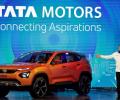
Under its Turnaround 2.0 programme, Tata Motors will work to improve its sales capabilities -- "as the product itself is not enough" -- use experiential marketing to excite the market and cut costs to make its offerings more competitive.

While hybrids, CNG and biofuels found favour in 2018 among many carmakers including Maruti Suzuki, Mercedes-Benz, Toyota and Honda, others such as M&M and Tata Motors have shown full faith in electric vehicles.

'SUV is a very intensely fought category, unlike hatchbacks and cars.'

The Warren Buffet-backed Chinese electric vehicle manufacturer BYD will be unveiling a Born Electric SUV for the Indian market by the fourth quarter of the current calendar year. The deliveries of the same would begin in January, the company's top official said. This will be the first Born Electric SUV in the mass market. The Born Electric models from Tata Motors and Mahindra and Mahindra would be launched from 2024. BYD has been selling the E6 MPV in the Indian market since 2021.

Siam argues that a 2040 ban could destabilise ongoing and future investments and threaten millions of jobs in the automotive value chain.

Car sales likely to touch record 3-mn mark by the end of March.

Cumulative sales of India's top passenger vehicle makers -- Maruti Suzuki, Mahindra and Mahindra, Tata Motors, Honda Cars, and Toyota Kirloskar -- increased to 206,418 units in February over 200,322 units in the same month last year, an increase of 3 per cent.
BS-VI emission norms and the COVID-19 lockdown impacted the dispatches.

Tata Steel and Indian Hotels on Wednesday said they have always made all relevant disclosures and have no further comments to offer following comments made by ousted Tata Group chairman Cyrus Mistry that Tata group firms could face a potential USD 18 billion writedown.

Bajaj Auto has become the top player in India's electric vehicle market by monthly volumes, across all categories, with over 25,000 sales and registrations in September. This comes on the back of a big push in expanding distribution by the company and steady demand of electric three-wheelers. In September, the company - according to the latest Vahan data - recorded sales of 17,570 electric two-wheelers, 4,575 three-wheelers, and 3,000 Yulu low-speed electric bikes (based on company sales numbers), which do not require a licence and are not registered on Vahan.

Major automakers, including Maruti Suzuki, Hyundai, Tata Motors, Mahindra & Mahindra, Kia, Toyota and Honda, on Thursday reported healthy growth in passenger vehicles sales in June, recovering from the disruptions induced by the second wave of COVID-19. The country's largest carmaker Maruti Suzuki India (MSI) posted total sales of 1,47,368 units in June, up from 46,555 units in May. Its domestic dispatches to dealers last month stood at 130,348 units, up from 35,293 units in May, as easing of COVID-related restrictions helped the auto major to dispatch more units to dealerships.

Maruti, Hyundai, Tata Motors, Mahindra & Mahindra and Honda saw their passenger vehicle sales improve in August compared to the same month last year, although Ford and Toyota witnessed a decline.
The sharp increase in commodity prices on account of the Russia-Ukraine war has put automakers in a fix. After the frequent price hikes in the current fiscal, manufacturers fear that any more price increases may further dent the already weak demand in certain segments. "We have taken several hikes and cannot immediately do it again. "We will have to closely watch the situation and act accordingly," said an official at an auto firm, declining to be identified. Even for companies like Tata Motors Passenger Vehicles, which has had a strong volume run and a robust order book, passing on the entire costs has been tough.

China's covid crisis could provoke a raw material crunch for India's EV industry later this year.

With nearly 100 launches and unveils, the Bharat Mobility Global Expo 2025, held in Delhi from January 17 to 22, made one thing clear to automobile enthusiasts: Electric vehicles (EVs) are the way ahead for the Indian auto market for years to come.
Utility segment at present constitutes 17-18 per cent of the total car market in the country.

Market watchers believe Tata Motors' move to upgrade the Nano is a right decision.
While customers in metro cities are still buying cars, quick growth is likely only from upcountry markets, where highways and roads are being built, and discretionary income and aspirations are rising.

First-time buyers of cars and sport utility vehicles (SUVs) have made a comeback, shows last year's data from top passenger vehicle (PV) makers. If the trend persists, it may move the needle on the overall car penetration ratio. India's car penetration ratio is 32 per 1,000 people - one of the lowest, compared to mature car markets like the US and Europe.
Tata Motors Ltd, which has just emerged as the number two passenger vehicles company in the country, said on Friday
Automobile manufacturers are likely to report strong numbers for the September quarter of Financial Year 2023-24 (Q2 FY24), riding on growth across segments and offset by a marginal drop in overall two-wheeler (2W) volumes. Higher average selling price (ASP) year-on-year (YoY), which was necessitated by price hikes taken by original equipment manufacturers (OEMs), and an improved product mix will also aid revenues and margins. Moreover, commodity prices are down on a YoY basis, leading to higher margins in earnings before interest, taxes, depreciation and amortisation (Ebitda).

After years of losing money on two of the group's biggest bets - global steel business and domestic passenger cars - there are strong signs of a revival in both businesses.

On the other hand, the group's two traditional cash cows, TCS and Tata Motors' subsidiary Jaguar Land Rover, are slowing as other businesses pick up pace

Among Sensex firms, Bajaj Finserv and Bajaj Finance fell by over 4 per cent each. Nestle, Infosys, Tata Consultancy Services, Wipro, UltraTech Cement, HCL Technologies, Larsen & Toubro and Hindustan Unilever were the other major laggards. Bharti Airtel, State Bank of India, Sun Pharma and NTPC were among the gainers.

Maruti Suzuki, Hyundai, Mahindra and Toyota reported low single-digit sales growth for the month owing to weak market sentiment
A financial turnaround in Tata Steel and Tata Motors has come as a shot in the arm for Chandra.

The auto industry has had a mixed month. The build up to Dhanteras and Diwali was good but the demand tapered off subsequently.

Indian Hotels, Tata Steel, Tata Teleservices, Tata Motors, Tata Power need some immediate attention of the Tata Group chairman
Maurti and Hyundai recorded jump in sales in May.

Which were the five businesses Ratan Tata had great hopes for, but his successor failed to deliver?

Even as India's passenger-vehicle sales touched a record high of 3.9 million units in 2022-23, growing 27 per cent over the previous financial year, the country's largest carmaker, Maruti Suzuki India (MSIL), said on Monday uncertainties in the electronic-component supplies might affect production in FY24. MSIL said the shortage of electronic components had some impact on production in FY23. "The company took all possible measures to minimise the impact.

Six months after its India debut, the Vietnamese automaker has overtaken established players such as Hyundai Motor, BMW, Kia, and Chinese EV major BYD.
